Repair 1 min read
Patch repair that fails in eighteen months
Chloride-contaminated concrete, incipient anode formation, and what a proper breakout looks like.
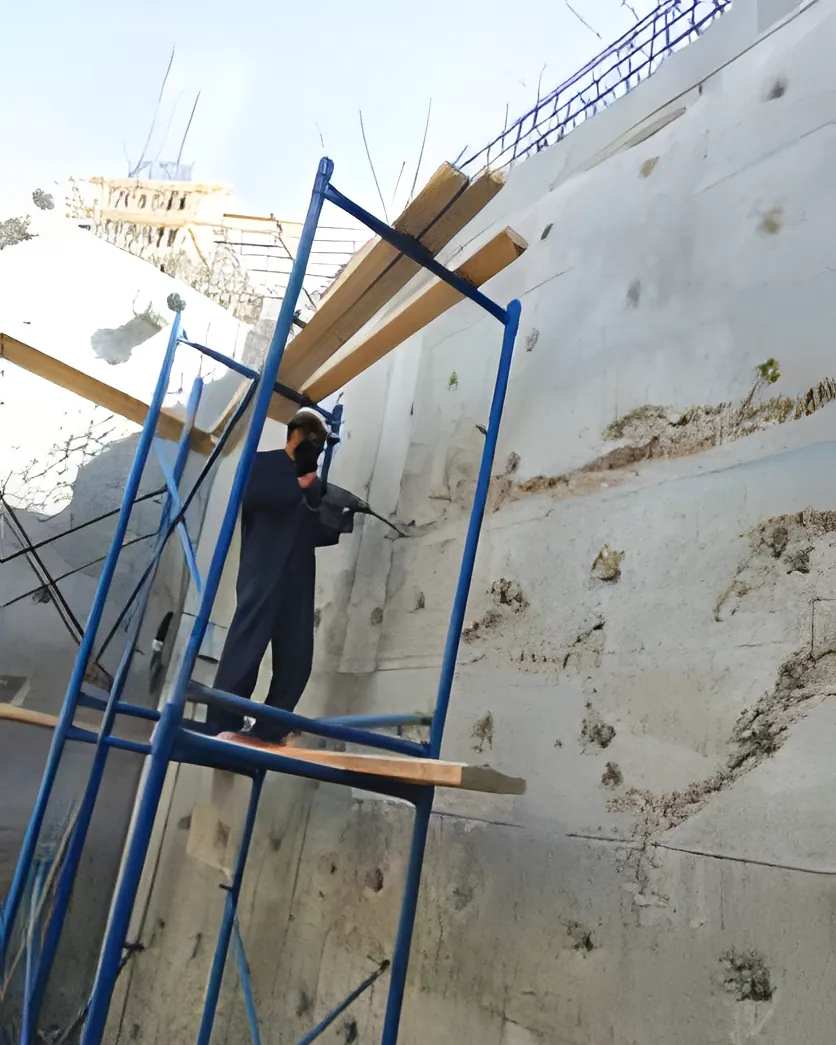
A patch repair that fails within two years usually failed on the day it was placed. The visible spall was removed, a repair mortar was applied, and the chloride-contaminated concrete immediately beside it was left alone.
That untouched concrete still carries chlorides. The new repair is alkaline and passive. The two are now electrically coupled through the reinforcement, and the steel at the edge of the repair becomes anodic to the steel inside it. The result is a ring of new corrosion around a sound patch — the incipient anode effect, and it is the single most common reason repairs come back.
The repair is not the problem; the concrete beside it is
Avoiding it means breaking out past the visible damage until the chloride content is acceptable, which is almost always further than anyone wants to go, and testing rather than guessing where that line is.
- Break out to sound, uncontaminated concrete — half-cell survey first, chisel second
- Expose the full circumference of the bar, not the visible face of it
- Match the repair mortar's modulus to the parent concrete, or the patch debonds on its own
Where breaking out far enough is not possible, the answer is not a bigger patch. It is a galvanic anode or a full cathodic protection system — a different trade, a different price, and a conversation to have before the scaffold comes down.
Have this problem on a live job?
Send us the drawings and a photograph — an engineer will come back the same day.
More from the technical office
What a FINA-approved pool actually requires
Tolerances, finishes and the equipment schedule that comes with the approval.AGIAL technical office18 Sep 2026
Choosing between epoxy, PU and hygienic vinyl
Thermal shock, chemical exposure and cleaning regime — three questions that settle it.AGIAL technical office18 Sep 2026